
Brooks Vantage Supreme

I heard it before I saw it—a revving engine bookended in a tiny gap of silence between Scott Koreski calling me an asshole and me yelling back I was going home to grab my note cards.
I turned to see the grille of a car doing about 60. When I see the driver in my mind, she’s more poem than human: curly black hair, a crying child, blue Adidas shoes walking through a field of flowers.
Time stood still.
Not ‘still’ exactly—more like cut into frames. I felt the bumper push into my leg and heard the crack of bones. My head hit the windshield. Flying through the air, I saw a tree. Its branches were bare. I thought, Of course, its branches are bare. It’s winter.
I remember lying on the ground. A fire hydrant with a red smear of paint. A child’s face. His mouth moved, but I heard no sound.
Everything went black. The peace was broken by a kaleidoscopic explosion of sirens and faces. My pants had been torn off, and the bones of my leg were sticking out.
Black again.
On the Tuesday before Christmas break, I remember being excited about the upcoming two-week vacation, but nervous because the following day was the Christmas Mile. I’d failed miserably the year before and vowed this time would be different. For starters, I wouldn’t pound pancakes with David Pendley at McDonald’s the morning of the race.
The Christmas Mile was the only annual sporting event my junior high school held. From being the odds-on favorite in October, the dynamic had changed due to the arrival of a new kid at school from Mexico named Sergio Martinez.
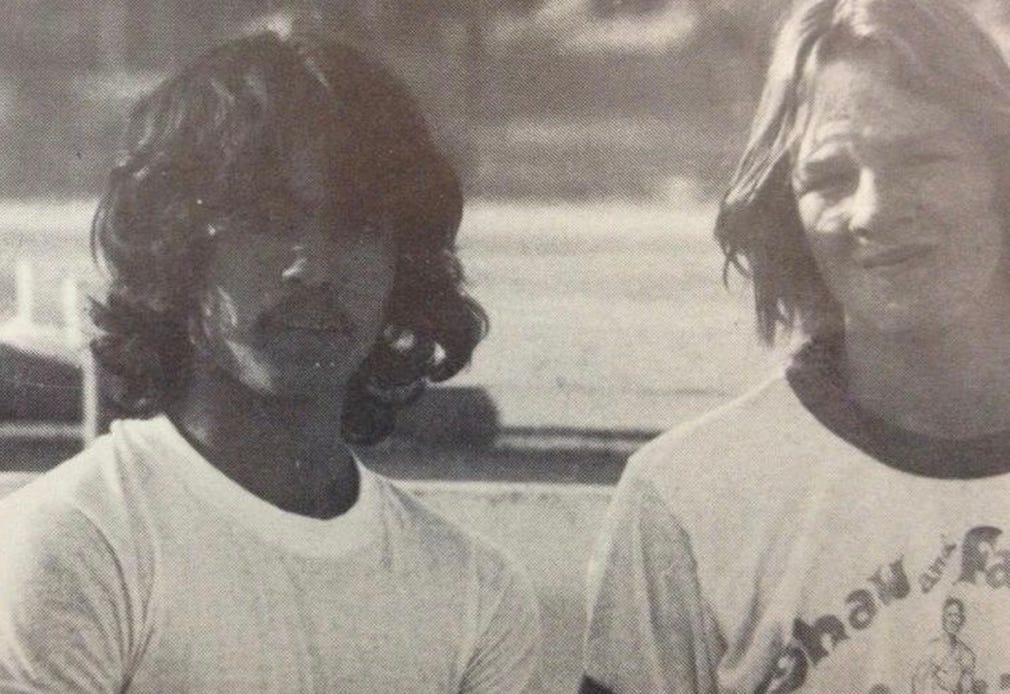
Sergio was fast as hell, the best natural athlete anyone had ever seen, and had a mustache. I’m not saying he was a 16-year-old eighth grader, but that was the rumor, and it made some of us feel better about ourselves on the athletic field.
Before the race, my PE teacher, Mike Driscoll, came up and said, “Red, I don’t know if you can take this kid. He runs like the wind. If you lose, don’t be hard on yourself.”
He leaned in close and whispered, “I heard he’s fifteen,” and patted me on the back.
Some friends told me that I had it in me to do it and that they were rooting for me, but there was an emptiness to their words. Doubt was gnawing at me. Making matters worse, 100 yards into my jog/warm-up, I was struck by an incredibly painful thing that felt like a knife stuck in my groin that had been plaguing me for a year and a half. I discovered later that the pain was caused by testicular torsion, a condition where the spermatic cord is twisted. It was so painful, it would stop me in my tracks when it struck.
The bell rang, and 800 kids spilled out of class and lined up around the track. The majority of the kids in my school were Hispanic, and a lot of them were hard-core chukos (i.e., vatos, pachucos, or cholos). As a white boy, I was in the minority. As a freckly, red-headed white boy, I occupied my own planet. In my heart, I felt at home in a Mexican community. It was a bond forged through shared historical experiences, soccer, boxing, and Catholicism. My nickname was pelirrojo.
Wincing through the testicular torsion attack, I tried to stay cool as I jogged by a group of chukos chilling by the goal posts on the north side of the track.
“You’re gonna lose, pinchi güero,” cracked a dude whose gang name was Sleepy. A lot of chukos in the ‘70s took their gang nicknames from the Seven Dwarves in Snow White.
I did some strides through the center of the field and prayed to God to take the pain away.
Sergio was jogging around, joking with some of his buddies, when he looked over at me. I immediately broke eye contact and focused on a fence across the field. He’d won round one of the fight. I bent over to touch my lucky green and black Nike Waffle racers and repeated a mantra made famous by the gold-medal winning high jumper, Dwight Stones: “Feet Don’t Fail Me Now,’— something Dwight had stolen from a Chitlin Circuit’ act.
We were called to the starting line, and I fell in place. Struggling to control my breathing, panic was setting in. My groin was throbbing. This will go, I said, to myself right before the starter called out, “Runners to your marks!” and then fired the pistol.
The beginning of the race was a clusterfuck. Races always are. Guys you know are going to fade still blast out like rabbits. There’s bumping, pushing, jostling, and the game is to stay on your feet and get free of the traffic. Around the 110-yard mark, Sergio settled into the lead with me just off his shoulder. We passed a band of chukos hanging by the football goal posts who yelled, “¡Ándale pues! Kick his ass, Sergio!”
The crowd thinned on the west side of the track, but I focused on the invisible knife lodged in my groin, and on watching Sergio’s long, black hair bounce up and down as I followed him around the track.
As we rounded the final turn and came back to the starting line, everyone was screaming. I was in pain, but I remember seeing a couple of my favorite teachers—Mr. Hawkins and Mrs. B—jumping up and down with excitement. The starter called out the split times: “73, 74.”
Damn. We went out fast.
I took the lead. As we passed the chukos again, they were angry at Sergio.
“You better not let this güero beat you, ese!”
Sergio, like me, was dealing with his own kind of pressure. He, too, was scared to fail in an athletic competition with racial overtones.
For the next two laps, Sergio and I passed each other while my friends cheered and encouraged me while his friends cussed me out or threatened Sergio if he lost. Lapping the slowest runners, I worried the slowpokes could become a problem on the last lap.
We hit the starting point again for the bell lap, and I got depressed thinking about how two years earlier, as an 11-year-old, I could have handled the pace better than I was dealing with it at 13. 50 yards later, suddenly, miraculously, the pain in my groin disappeared. Passing the chukos for the last time, Sleepy cackled and said, “He got you, white boy!”
Feeling strong, I dropped back to study Sergio’s gait. He was struggling and his arms were tight. Through the backstretch, I rode his shoulder, and as we hit the curve with less than 200 yards to go, I started my kick and left Sergio in my dust.
After I crossed the line, things were a blur. Teachers hugged me, friends slapped me on the back, while others cussed and booed. I felt like Peter Strauss in The Jericho Mile.
Sergio and I shook hands. He looked like he was going to cry. The pressure on him to represent had been enormous.
The rest of the school day, I was floating. My English teacher, Mr. Hawkins, reminded me he wasn’t going to cut me any slack on a big term paper that was due that Friday because I ran the race.
Who cares about Friday? I thought. It was Wednesday, I’d won the Christmas Mile, and I was happy. That night, I thought about working on the term paper, but was so tired, I fell asleep listening to Pink Floyd’s Animals on eight-track.
The next morning was the usual pandemonium in my household. Four kids fighting for time in one bathroom, while my mom and dad scrambled to get out the door for work. Like me, my father was a runner, and a really good one. He was also a cheapskate when it came to buying anything for himself. Recently, I’d convinced him to stop using Shoe Goo on his old trainers and buy a new pair of Brooks Vantage Supreme running shoes in a size 10—my size. There was a method to my madness.
As my father picked up his briefcase, I asked if I could wear his new shoes to school.
“Hell no!” he snapped. “I just got them. I haven’t even taken them for a run yet.” Watching my dad pull out of our driveway, I thought, what he didn’t know won’t hurt him, and put the Brooks on anyway. Besides, they matched my dark blue Levi’s cords and Hang Ten T-shirt.
That day at school, Coach Driscoll let me take PE off because I’d won the race. I was joking with friends when Scott Koreski asked if I had finished the research paper for Mr. Hawkins class.
“I got all my index cards done. I just have to write it.”
Scott suggested I meet him at his house after school, and we could go to the library on State Street together and get it done. After school that day, I met Scott by the bike rack where I unlocked the Torker I bought from Billy Phillips for $75.
We rode to Scott’s house by the Women’s Ten Thousand Club, and Scott made sandwiches to eat before we went to the library.
“Oh, shit!”
“What?” asked Scott.
“I forgot my index cards at my house.”
Scott told me not to worry about the cards and that I should have a sandwich and get them later.
“It’ll take me fifteen minutes to get to my house and back.”
I took off on my bike just when Scott stepped out his front door and yelled, “Have a sandwich!”
Glancing over my shoulder, I said, “I’ll be right back.”
I rode blindly into the intersection and directly into the path of a Datsun that had blown a stop sign.
I remember turning to see the front of a mustard-colored car and the bare branches of a tree as I flew through the air before everything went black. When I came to, a young woman’s face was in mine. She was repeating, “Oh, fuck! Oh, fuck!”
I passed out again, and the next time I came to, I saw a crowd of kids from the neighborhood had formed a ring around me. I remember the excitement on their faces—like I was the blood-and-gore-Friday-after-school special.
To my left were an ambulance and a fire truck. My pants had been slit open, and bones had ripped through the skin of my right leg. Scott held my head and told me I was going to be okay while a paramedic picked up large shears. He lifted my foot gingerly off the ground.
“No!” I yelled. “Don’t cut my shoe off! My dad will kill me!”
Snip.
The next thing I remember was riding in the back of the ambulance for the short ride to the hospital.
I was wheeled on a steel gurney into a room by an orderly who told me I had to wait while they tried to find a doctor.
“Could be hours, bro,” he said.
I asked if Scott could be with me, but the man said it was against regulations. My right leg was like a prop from a horror movie.
I stayed in that room for hours. Only one person came in to check on me—a tall, heavy-set orderly.
“You the kid on the bike, huh?” he asked.
I nodded.
“And you weren’t wearing a helmet?”
I shook my head no.
In 1979, the only people in the world who might have worn helmets on bicycles were bike racers in the Olympics velodrome. Even the Tour de France guys wore small, Euro-style, quasi-baseball caps.
The guy wheeled my gurney to an adjacent room where a corpse lay on a slab. Whoever it had been had no face. Their head, from their neck to the top of their skull, was a bloody glob.
“They just scraped this one off of Interstate 8,” said the orderly. “Motorcycle accident. He wasn’t wearing a helmet.”
I was in shock. I’d never seen a dead body before, certainly not one so mangled. “I was riding my bicycle,” I said. “I wasn’t on a motorcycle.”
The man wheeled me back to my room.
“Why did you do that?”
The man ignored my question. “They’re waiting for a doctor to come down from San Diego. Might take a long time.”
I think about that man often and what was going on in his mind when he wheeled me into that room.
Hours passed while I was alone on a steel gurney in that freezing room with no water, no blanket, no company.
Where is my family? I wondered.
When the doctor finally arrived, he drove a horse needle into my spine.
“I’m not promising I can save this leg,” he said, “but we’ll see.”
I watched in a drugged haze as the doctor lifted my leg and examined it.Torn bits of tendons and muscle hung off my splintered tibia and fibula.
The next day, when I still had some strength, I was able to get up with a nurse’s help to the bathroom. It was the last time I would be able to stand or sit up on my own for the next six months.
At the end of my first week in the hospital, a nurse told me I had visitors and asked if I was up for some. I was in an incredibly dark place and said I wasn’t sure. She said they weren’t in the hospital. That confused me. She walked around my bed and opened the curtains, and outside my window was a huge gang of kids from my junior high with my bike, completely re- done, with fancy hubs and rims and all.
Holding my bike stood my friend George Jimenez. George was someone I could talk about heavy stuff with, and he could share the same with me. It was rare to have a friend with such a high EQ at that age. My friends had taken up a donation around the school and had, with the help of the owners of the Finish Line bike shop in El Centro, built me a beautiful new bike. To this day, hands down, it’s the most beautiful gift (and gesture) I’ve ever received.
After a few weeks in the hospital, my parents came to take me home. I tried to stand and use crutches, but passed out, so my dad and a nurse carried me to the back of my parents’ Buick station wagon and laid me down in the back.
When I got home, my parents put me on a couch sectional we’d recently bought at Long’s Drugs, a drugstore that sold cheap toiletries, ice cream, and furniture. It had two sections extending at 90-degree angles from a central table with a built-in eight-track player. That eight- track player kept me alive for the next six months.
The next six months were the darkest stretch of my life. Every day, I was left alone on that cot with only books, and Beatles, the Stones, Jimi Hendrix, and Pink Floyd 8-tracks to keep me company. When I had to pee, I did so in empty tennis ball canisters placed by the cot for that purpose that my little sister Karina would empty when she got home from school each day.
I stopped eating, lost half my body weight, and developed bedsores. While I remember my sisters spending time with me, I didn’t see my parents much. I think they didn’t know what to do with me. I had no doctors’ appointments or physical therapy sessions. Every day, I would lose my mind and regain it, sometimes in the same five minutes. From being an eighth-grader high school coaches salivated would soon be on their rosters, I was suddenly no longer an athlete. Running, soccer, and tennis were gone. They’d been my life—my identity. They were how I was known and defined.
One day, a friend of my older sister, Eileen, a nurse named Joanne Fries, saw me and screamed, “What are you doing to this child?” at my parents.
That’s when things happened. I was taken to a doctor to treat the bedsores and start the physical therapy I’d need to help me learn to walk with crutches. The day I first returned from the doctor, I asked to be set up on a chair in my backyard so I could sit in the sun. My body was covered in a disgusting rash. It was itchy and oozing blood. I reached into the gap between my cast and thigh to scratch an itch, and a big mush of skin came off in my hand. More than anything else, that broke me. I’d held everything in since the day I was run over, but I couldn’t any longer.
Over time, I got the strength to walk on crutches, and then, to walk without a cast. I remember my first light jog of 20 meters on soft grass. It was the first day of high school cross country practice. Coach Dornan told me to take it easy and come back the following year, but I was determined to stick around.
At the Desert Valley League J.V. Championship that year in Heber Beach, I took first and was promoted to the varsity team for the California Interscholastic Federation Cross-County Championships. Almost a year after my accident, I had earned my varsity letter in cross- country.
Years later, I was back in El Centro where I ran into Clyde Carson’s niece. I asked her how her mom and uncle were doing. She said they were fine, but that Clyde’s wife was going through a hard time because her sister, Teresa, had just died. Apparently, the woman had struggled with drugs for years and lost the battle.
“Send Clyde and his wife my condolences,” I said.
“You should call him yourself. He’d love to hear from you.”
Clyde and I arranged to meet at a new coffee place that had just opened in the city of Imperial. When I got there, I was surprised to discover a proper café with a stage for acoustic music and poetry readings. I met the owner, a man from the Philippines, and we chatted while I waited for Clyde.
When Clyde arrived, we ordered coffees. He told me about his wife’s sister, Teresa, had died.
“I heard about it from Emily,” I said. “Real sad.”
Clyde looked at me with a confused expression. “Don’t you know who Teresa was?”
“I know she was Tecia’s sister and had a drug problem.”
Clyde leaned closer. “Teresa’s the woman who ran you over,” he said. “Her whole life, she felt guilty because she was so damn high when she did it.”
I immediately thought of Teresa’s face in mine, back on that street, nearly 30 years earlier, yelling, “Oh, fuck! Oh, fuck! Oh, fuck!”
Whether she was high or going too fast, I was in the street before I’d turned to see if there was any traffic.
It wasn’t Teresa’s fault.
It was mine.
I wished I knew her. I wished I could’ve told her the accident was my fault.
That night, I searched the internet for Teresa’s obituary. Even though she was 46, I recognized her face as the terrified teenager. An obituary said she loved to read and was happiest spending time with her family. From what I gathered, it’s a family that has seen way more than its fair share of tragedy. She had been predeceased by two daughters—one, not long after the accident when Teresa couldn’t have been more than 18 or 19—and another just recently.
Have a sandwich, or not? The dice roll of choices—the ones that have catastrophic consequences, and the ones that save us from catastrophe.
Todo.
Ouch. Both to the accident itself and to the ending. Also, I realize it's not really the point, but I watched a friend go through torsion years ago, and I don't know how the hell you ran with that in the first place. Ouch from start to finish.