
Griddle Cakes

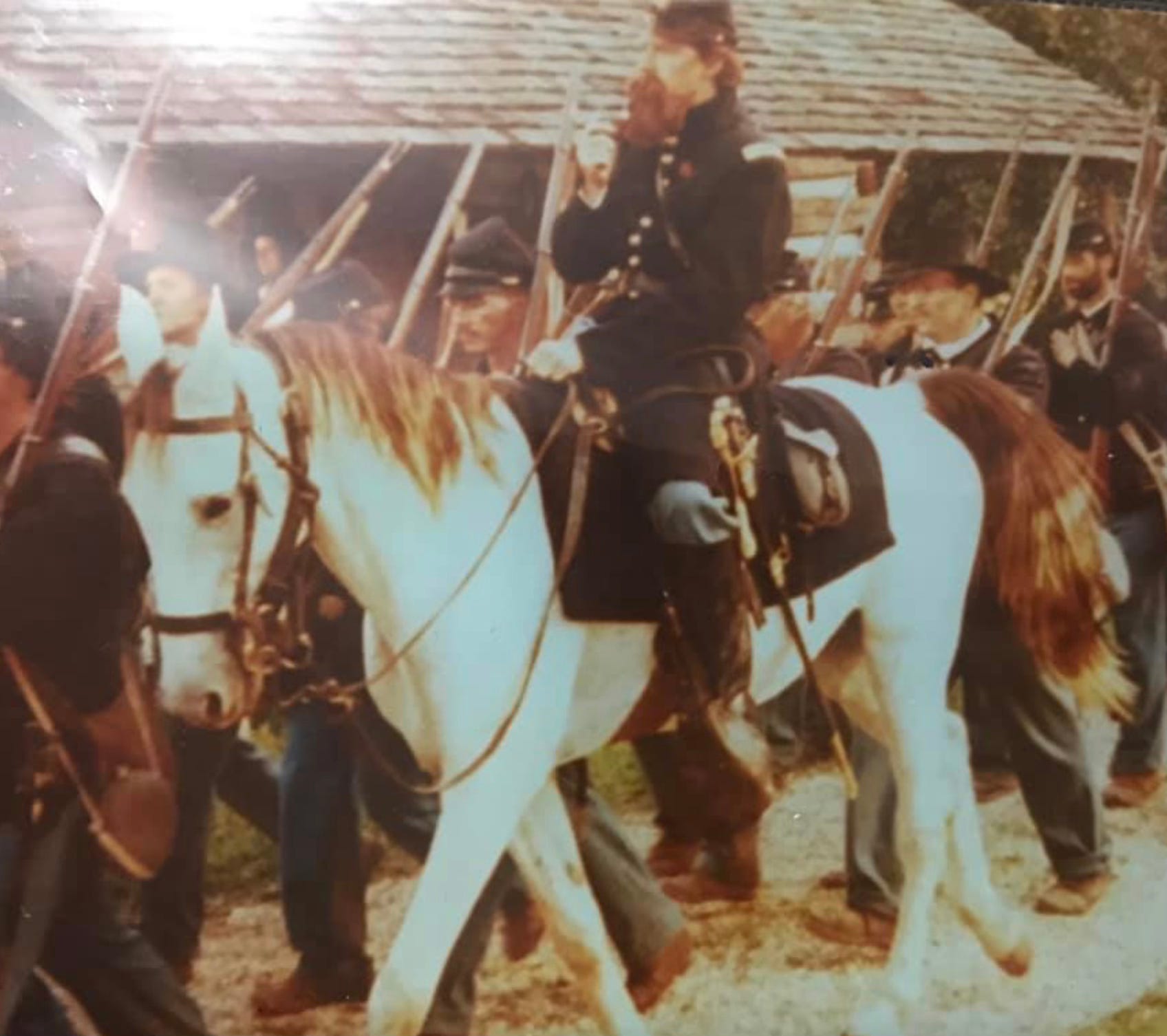
For a little less than ten minutes, Joy Todd’s office transformed from a tastily furnished office in Hollywood into a misty hillside in southern Pennsylvania circa 1863. Performing a scene from the film Gettysburg, I made sure I clearly specified the geographical location of the combatants. Standing with the Union Army, I placed the Confederate Army somewhere on the other side of the 101 Freeway in the direction of the Hollywood sign. I wandered to the window, took a long, hard look, and said, with a tinge of bravado, “Damn. Johnny Rebs. Hiding like rats in Devil’s Den.”
The situation my cohorts and I in the 20th Maine Volunteer Infantry Regiment found ourselves was dire. After successfully repelling wave after wave of ferocious attacks by the 15th and 47th Alabamans under the command of Evander F. Law, we were surrounded. Colonel Joshua Lawrence Chamberlain (played in the film by Jeff Daniels, but on that afternoon by a casting associate) and I conferred what to do
Me: “We can’t hold them again sir, you know that.”
Chamberlain: “Well if we don’t, they go on by, over the hill, and the whole flank caves in,”
Silence. Wheels turned behind our eyeballs. The preservation of the Union depended in large measure on what Chamberlain would do. We were trapped on Little Round Top, a small, de-treed hill, which represented the end of the left flank of the Union Army at Gettysburg. If they could break our line, they could outflank the Union Army and would have a straight shot to Washington, D.C. from the North. It’s not hyperbole to say the War hung in the balance.
The associate pointed to a make-believe pod of men stirring in the parking lot below. The 15th Alabamans were gearing for another charge.
‘We can’t run away,” said the guy playing Chamberlain. “If we stay here, we can’t shoot. Fix bayonets.”
The two of us, scripts in hand, glanced nervously at each other. We knew full well the implications of a bayonet charge. It was suicide. We maintained silence, building the tension. Most good acting happens in silence, not when lines are being delivered. Damn, I thought, I like this casting associate. He’s good.
“We’ll have the advantage of moving down the hill,” said the man playing Chamberlain. “They gotta be tired, the Rebs, they gotta be close to the end if we are, so fix bayonets. Ellis, wait Ellis, you take the left wing, I’ll take the right. I want a right wheel forward of the whole regiment.”
In my mind, I silently repeated the well-known slogan for a Maine-based bread company: Pepperidge Farm Remembers, to keep my accent on point.
“What? You mean chahhhge?”
“Yes. But here’s what we’re going to do. We’re going to chahhhge swinging down the hill, just like we pulled back this left side of the regiment. Now we’re gonna swing it down. We swing like a dooah. We’re gonna sweep them down the hill just as they come up. Understand? Does everybody understand?”
“Yes, sir!”
“Okay, Ellis, you take the left wing, and when I give the command, I want the whole regiment to go forward, swinging down to the right.”
I paused briefly, weighing the implications. “All right, sir. Fine.”
“Move. Bayonets!!”
I ran around Joy’s office (exploring the space, in actor-speak), regaling invisible men with cries of “C’mon lads! Quickly boys! Let’s go!”
Turning my back to the approaching enemy, I faced my men, and yelled, “Fix Bayonets!”
After waiting a beat to allow for an unheard bugle call, I screamed, “Chahhhge! I swung my script/sword, and bolted toward the window.
The audition was for a film Ron Maxwell was directing based on Michael Shaara’s Pulitzer Prize winning book, The Killer Angels. When we actually shot the scene, months later, the charge was more disorganized. We were losing light and with it, our chance to film the iconic scene. Take after take, men shouted in agony while over a bullhorn the First AD screamed, “Back to one!”
On one take, I heard the unmistakable crack of bone when a background actor fell next to me. The collateral damage suffered by older reenactors who’d fallen in the assault filled the air. Each take, I sprinted as fast as I could to avoid the hundreds of muskets with real bayonets affixed to them from impaling me. One slip, combined with the momentum of the mass of men behind me, could have easily led to a lacerated ass, or worse. Every time I passed the cameras at the bottom of the hill, I clambered up a tree so stumbling reenactors wouldn’t accidentally kill me.
When I finished the audition, I felt confident. I could tell Joy was picturing me in Union Blues.
“Can you ride a horse?” she asked.
“Like the wind,” I said, without missing a beat.
“Thanks, We’ll be in touch. You work with Perri, right?”
“Yup.”
Just asking for my agent’s info made me know she’d be inquiring about my availability and quotes. It was a good sign.
I left on a high and immediately drove over Barham to the backside of Griffith Park to the LA Equestrian Center and told a lady working there I needed horse riding lessons for a movie.
“Western or Eastern?”
“It’s for a Civil War movie.”
“The saddles will most likely be Western, big fat Cadillacs, but I want you to start with Eastern. You’ll get better training.”
“What’s the difference?’
She pointed to a woman riding around a pen on a stallion. Deep in her stirrups, heels low, she posted by thrusting her hips forward with each move of the horse. The saddle looked like the size of a postage stamp.
“She’s… “
“It can look funny,” said the woman. “It’s called posting. Posting’s like humping the air.”
I hadn’t ridden a horse since the time I’d gone blasting across a Mexican beach in San Felipe years earlier. I started intentionally over-posting, punctuating each thrust with a weird facial expression, Monty-Python style, trying to make the instructor laugh. She chided me to get serious.
When I arrived in Gettysburg, the flick had already been in production for almost two months. The director, Ron Maxwell, filmed the miniseries by covering the Confederate side of the story first. Martin Sheen was playing General Robert E. Lee, Tom Berenger, Longstreet, and Stephen Lang, Pickett. A lot of amazing people had cameos in the film. I met an actor/musician named Alex Harvey in the lobby of the Gettysburg Holiday Inn. I asked him how it had been going and he said it was a blast. Every night the cast and crew took over a tavern in town, and it was like a big party. At some point over the course of the conversation, Alex told me Ron Maxwell cast him in the film because he was a fan of a song he’d written back in the ‘70s, Delta Dawn.
“You wrote Delta Dawn?”
“Yes, sir.”
My mind flashed back to Windham, New Hampshire in 1972. I was eight. Every day, the bus picked me and my sisters up to take us to Golden Gate Elementary School. The scene was generally your standard kids-acting-wild-on-a-bus-free-for-all until Delta Dawn (Tanya Tucker’s cover of Alex’s song) came on the radio. The bus driver would crank it up and we’d sing along at the top of our lungs. I’ve never remembered a song bringing people together as powerfully as Delta Dawn did on that bus with us kids. It was a beautiful, profoundly spiritual, experience. There was no irony to it. Everyone sang as well and as loud as they could. I asked Alex how filming was and he told me it was great. He said that thousands upon thousands of guys had come from all over the country to take part in the film as Civil War reenactors, on their own dime. They’d made camp in the Valley with only period tents and blankets to protect them against the coming cold.
“There’s no way Ron could do this movie without them. They brought their own uniforms, horses, and weapons. It’d cost Ted Turner (the film’s financier) an extra hundred million if we didn’t have them.”
My first day of filming arrived and I met Sam Elliott as he was packing up his jeep to leave. He played General Buford, one of the Union’s finest. He told me he drove to every job he did wherever in the States or Canada they were filming. It’s something I’ve done on every job since.
My fellow 20th Mainers were a great bunch: Jeff Daniels, C. Thomas Howell, Mark Moses, Matt Letcher (a young talent Jeff had found from his regional playhouse in Michigan), Scott Campbell, a young Irishman named Barry McEvoy (who I stole the idea of my Harp tattoo from) and various other great character actors. We’d ride together at lunch, joke around in costume, curse the massive glue-on beards we wore on our faces. Since it was too dangerous to smoke cigarettes with all the adhesive glue, I took to smoking a pipe, something I worked into my character.
Then, there were the reenactors. Just as Alex had described, these men had come from all over the country and worked for free to be part of what was the largest, most realistic, and greatest reenactment of the Civil War in history. The documentarian, Ken Burns, had a small cameo in the film. During one sequence of cannon fire Ken told me (while we were lying on the ground, covering our ears with our hands) we were experiencing the largest cannonade since the Civil War itself. The sound was deafening, the ground shook. He said compared to the number of cannon actually fired before Pickett’s Charge (one hundred and fifty on the Confederate side, seventy-five for the Union) and the amount of gunpowder used in the charges, what we were experiencing was only a tenth of what it would’ve been like on that day. I couldn’t wrap my mind around that. He said hundreds of men were unaccounted for after the battle, many vaporized in front of cannons, without a stitch of clothing or shred of bone left behind.
One day, we were on the hill we were using to double Little Round Top. Unlike Pickett’s Charge and other famous events in the battle, we weren’t allowed to film on the actual battleground due to the difficulty getting equipment on the mountain and the number of memorial stones erected to mark the spot. Among the hundreds of cast, background, and crew members assembled, I recognized a man in the crowd.
“You wouldn’t happen to be from Boston, would you?” I asked.
The man saluted me stiffly and said, “Sir, yes Sir, Captain Speer.” He held his salute (mind you, we weren’t filming at the time) and avoided eye contact while I studied his face.
“Tom?”
“Yes, sir! My name is Tom, sir.”
I knew Tom. Tom lived in Allston, Massachusetts and was a regular at a bar called Shay’s in Harvard Square I bartended at in the late ‘80s. Over hundreds of pints of Guinness and bottles of Newcastle Nut Brown Ale I’d served him, he’d told me about his life, his work, heartbreak he’d experienced, his family. We’d been friends. I knew about his relationship with his mother.
“It’s me, Donal. From Shay’s.”
Tom not only didn’t look me in my eyes, he didn’t drop his salute. I was thrown. Clearly, he remembered, but on that hill, in those circumstances, he couldn’t break his duty as a soldier addressing a superior officer.
“How’s your mom?”
“She passed, sir.”
“I’m sorry to hear that.”
Tom nodded but held the salute.
“Listen, Tom. You don’t have to do this. You don’t have to salute. We’re friends. We’re the same people we used to be. If you want to hang, shoot the shit, whatever—I’m around. I’m here for you.”
“Appreciated, sir.” He stood ramrod style, still holding the salute, never once looking in my eyes.
It was sad. I couldn’t break through the facade
“As you were,” I said.
I found Mark Moses and a couple of the other guys from the cast. We talked about the reenactors—how dedicated they were, how married to the cause. We’d already seen glimpses into the intensity of their feelings. We were shooting a particular scene and needed some guys to switch uniforms to fatten the Union ranks on camera, and a number of Confederate reenactors refused.
“I will never wear the traitorous blue of the Army of Northern Aggression!” one older guy said, stomping off.
I thought about the War and things I’d seen, places I’d been. I thought of the sign marking the town line of Port Gibson, Mississippi, a place I’d lived a few years before: “Port Gibson, Mississippi — ‘A Town Too Beautiful to Burn,’ U.S. Grant.’”
I thought of the impressive war memorials I’d seen in small towns dotting both the North and South. each erected to honor the memory of men from the area who’d served and died in the Civil War. In many ways, the men were the same—they had families, jobs, dealt daily with the normal joys and difficulties of life. The marked difference was on the memorials themselves. In small towns in upstate New York for instance, they’d say, “In Memory of those who served in the War to Save the States.” In the South, the same memorial would read, “In Memory of those who Died in the War of Northern Aggression.”
It’s a divide in perspective that to this day has never fully healed. The intellectual Gertrude Stein wrote, “There will never be anything as interesting as that American Civil War.” Back with Mark and the other guys talking about the reenactors, who at that point had been living for nearly five months encamped in the Valley, the conversation turned to a man who’d died of a heart attack during the filming of the reenactment of Pickett’s Charge. Pickett’s Charge was a huge folly on the part of Lee and an amazing act of bravery. Wave upon wave of Confederate soldiers got mowed down marching across an open field under a constant barrage of fire from Generals Meade and Winfield Scott Hancock’s entrenched troops.
“What does production say to that guy’s wife and kids?” I asked. “Honestly. If you’re a producer, what do you tell the family of a guy who died making a movie?”
Out of nowhere came a loud, stentorian response. “You tell them he died defending the sovereignty and dignity of DIXIE!”
We turned and saw a massive man in a Confederate uniform. He casually lifted his boot and placed it on a rock behind us. He was eavesdropping and had clearly fired what was simply the opening salvo to a longer story he was bursting to tell. He placed one hand awkwardly on his hip and stroked his beard with the other.
“’Twas the second battle of Bull Run, ‘twat we call Manassas.” He stared into the distance as if looking at a misty field in Virginia, one hundred and thirty years in the past.
“We’d made camp and waited for Pope and his Yankees to fall for the trap Stonewall set for him. Trembling with the anticipation of battle, I tried to get some shut eye. At some point in the night, my tentmate got up to relieve himself. He had to urinate, understand?” He looked at us with a grave intensity. He also pronounced urinate “your-eye-nate,” with a long “i.” I was fascinated.
“’Twas then I felt a weight against me. The tent had collapsed. At first, I was confused, but found myself warmer and fell into a deep, beautiful slumber. When I awoke and climbed out of the tent, I discovered my tentmate had collapsed in the night and died of a heart attack. Rigor mortis had set in.”
Our mouths hung open. We wanted more, but he was not forthcoming, He removed his boot from its perch and dusted his pants with his hand.
“What did you do?” I asked.
He replied as calmly and matter-of-factly as if telling children why they shouldn’t play in the freeway.
“We covered his body with a Confederate Flag and commenced to make griddle cakes.”
He tipped his hat and walked away.
On the last day of filming, we wrapped early. I left the Holiday Inn for a run. My destination was Little and Big Round Top, some four miles to the south of the Holiday Inn. It was Autumn and the days were growing shorter, so I double-timed it. I reached Little Round Top just as the sun was setting and saw stone monuments marked with the names of men I’d become so familiar with over the past few months. I crawled down into the boulder-strewn Devil’s Den and looked up at Little Round Top. I was overwhelmed by the spirits that haunted the place, by all the blood that had been spilled there that had long since washed off the rocks and seeped into the soil. And I wept.
Thank you for sharing this story about your experience making the film Gettysburg. I just finished re-reading Tony Horwitz’s Confederates in the Attic - and saw your post! I grew up in the south and reenactors are so dedicated to telling the experience of the civil war.